





Anyone looking to buy a new duvet quickly encounters many technical terms: Fill Power, Fill Weight, 90% Down, 10% Feather…
But what do these specifications actually mean – and what should you look for when buying?
In this guide, we explain everything in simple language and help you find the perfect down duvet for your sleeping comfort.
1. Down vs. Feathers – and why quality is crucial
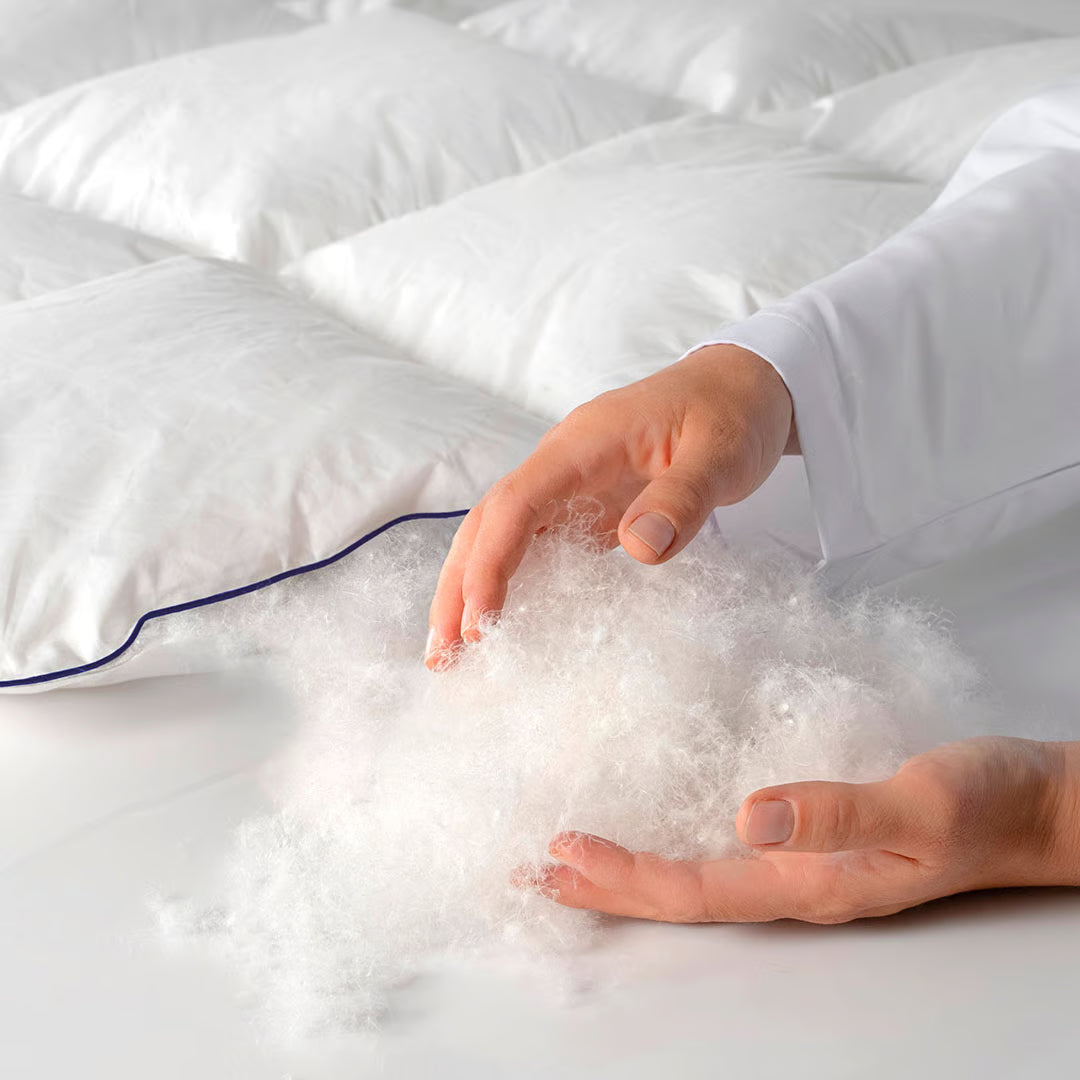
- Down are the soft, three-dimensional plumes under a goose's or duck's outer feathers. They consist of many fine filaments that trap air – perfect for warmth with minimal weight.
- Feathers are larger, flatter, and have a firm quill. They provide volume but are heavier and insulate less.
Quality Grades for Down and Feathers
Not all down and feathers are equal. Quality depends on:
- Animal species (goose or duck – goose is usually higher quality)
- Origin (colder regions → larger, denser down)
- Age of animals (older animals → fully developed, durable down)
- Processing (gentle washing, sorting, and drying preserves loft)
High-quality down is larger, loftier, and more durable. Cheaper fillings often contain many broken feathers, smaller down, or even residues, which significantly reduces comfort.
 Image comparison: Left "Made in Germany" manufacturer with "Peking Feathers" - Right fluffy French feathers (Calmont)
Conclusion: Quality is seen and felt – and it determines how warm, light, and durable your duvet or pillow truly is.
2. Fill Power – the measure of warmth with little weight
Fill power indicates how much down and feathers can fluff up. The higher the number, the more air is trapped – and the better the duvet or pillow keeps warm without being heavy.
- Below 500 = simple quality, often with many broken feathers, impurities, and less volume.
- 600–700 = good to very good quality, pleasantly warm with moderate weight.
- 700+ = premium quality, maximum comfort with minimal weight.
Generally, a higher fill power also ensures the typical voluminous loft of down duvets and pillows – they appear fluffier, recover more quickly after compression, and retain their shape for many years.
Important: A higher fill weight is not a guarantee of better warmth. High-quality down with high fill power often keeps you warmer with less weight – and feels softer and more pliable at the same time.
 Image comparison: Left standard down pillow – Right Calmont down pillow with high fill power
In the image, on the left, you see a 3-chamber down pillow from a manufacturer with lower, impure feather quality and a higher fill weight.
On the right, our Calmont 3-chamber down pillow: significantly lower fill weight, but much higher down and feather quality as well as superior fill power.
The result: More fill power, better air retention, and noticeably higher sleeping comfort – without unnecessary heaviness.
3. Fill Weight – More ≠ warmer
Many people think: "The heavier, the warmer."
This is only true if the quality of the filling is identical. In practice, a higher weight often does not mean more warmth, but simply more bulk – especially with inferior feathers or down.
Why less weight is often better
-
High-quality down with high fill power: can trap more air and therefore insulate better.
→ Result: Same or higher thermal performance with significantly less weight. - Lighter duvets and pillows: conform better to the body without creating pressure, thus improving sleeping comfort.
- Significantly better moisture regulation: Less material also means that moisture can escape more quickly – important for a dry, pleasant sleeping climate.
Practical example
A standard down duvet with 400–450 g/m² can have the same warmth as a Calmont premium down duvet with "only" 280 g/m² – the difference lies in the quality and fill power of the filling, not just the weight.
Note: When buying, don't just pay attention to the grammage, but to the interplay of filling weight, down content and fill power.
4. Cover material
The cover material of a down duvet or pillow is much more than just the outer shell.
It protects the filling, influences sleeping comfort and ensures that down and feathers retain their shape for many years.
Important properties of a good cover:
- Down-proof: Tightly woven so that no down or feathers escape and at the same time no mites or dust particles easily penetrate.
- Breathable: Supports moisture exchange and prevents heat build-up.
- Skin-friendly: Soft, pleasant feel that feels good even without bedding.
Please note: One of the great advantages of a high-quality down duvet is its high thermal performance combined with particularly high breathability. This advantage should not be negated by choosing an inferior cover material.
Fabric types
- Percale: Matte, firm cotton fabric, very breathable and robust – ideal for durable everyday duvets.
- Satin: Smooth, silky cotton fabric with a slight sheen, particularly supple and soft to the skin.
- Flannelette/Flannel: Lightly brushed, warm and cozy, especially for winter duvets.
Thread Count (TC)
The thread count describes how many threads per square inch of fabric are woven.
- 200–300 TC: Good for everyday use, durable and breathable.
- 300–500 TC: Very tightly woven, particularly soft and luxurious.
Tip: A tightly woven cover is more durable and prevents down or feathers from piercing the fabric – crucial for comfort and durability.
5. Finding the right size:
Single duvet or double duvet? This question arises especially for couples.
The answer lies in the sleeping needs of both partners.
Do you prefer to sleep warm, and your partner is usually too warm? We recommend choosing two single duvets to precisely meet individual sleeping needs.
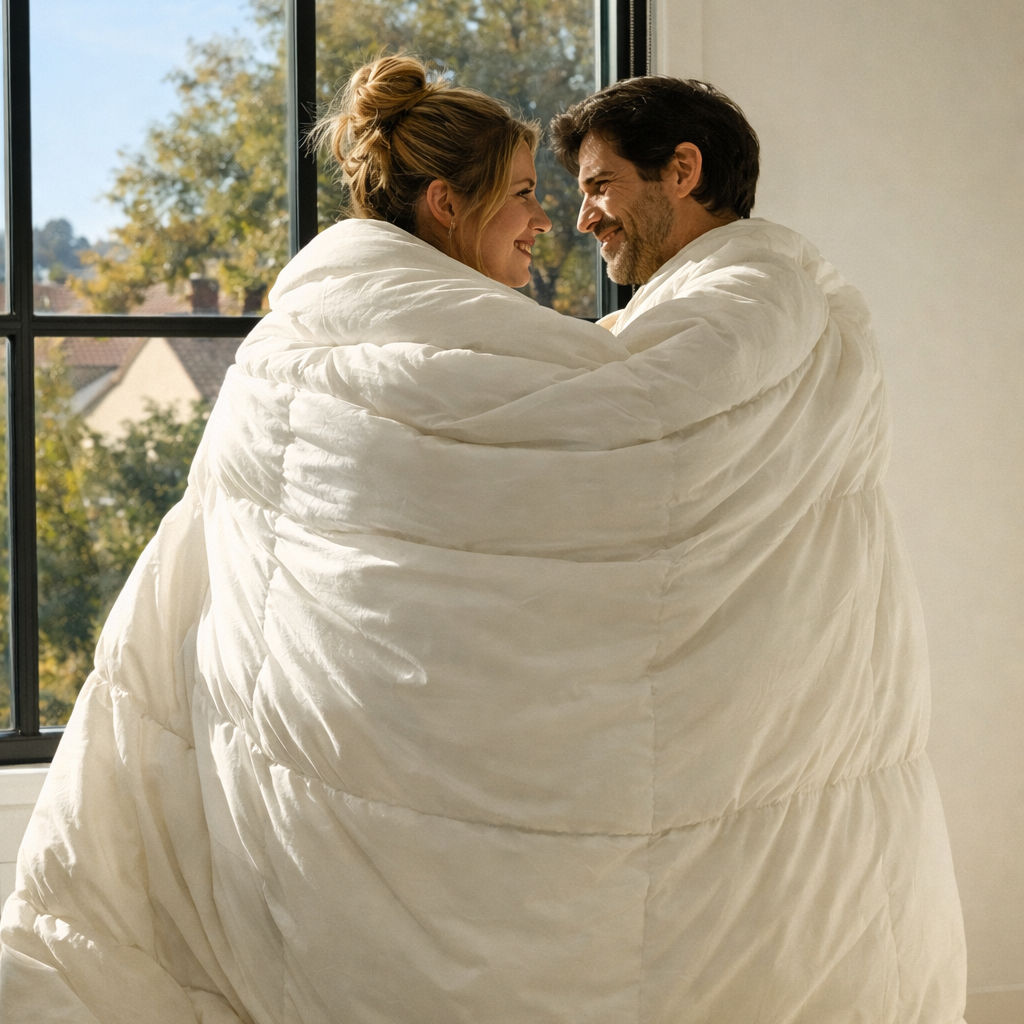
Or would you prefer to benefit from your partner's pleasant warmth and desire a shared cuddling experience? In this case, a large double duvet would be more suitable.
The following rules of thumb have proven successful for our customers:
The 180cm rule: For body heights of 180cm and above, we recommend choosing an extra length of 220cm or more.
For double duvets, be generous: Especially for double duvets, it is recommended to choose dimensions that extend generously beyond the bed edges to guarantee optimal thermal insulation.
When in doubt, choose the larger of two options.
6. Seasons & warmth ratings
Down duvets are available in different warmth ratings, suitable for your personal warmth needs and the season:
-
Summer duvet (Class 1–2)
Very light, low fill quantity, perfect for warm summer nights or heated bedrooms. -
All-season duvet (Class 3–4)
Medium fill quantity, ideal for use all year round in well-insulated homes. -
Winter duvet (Class 5–6)
Higher fill quantity, particularly warm, ideal for cool bedrooms or cold sleepers. -
4-season duvet
Two single duvets (usually summer + all-season duvet) that can be buttoned together for winter – maximum flexibility.
Tip: With premium down, a lighter warmth rating can often offer the same comfort as a heavier standard duvet.
7. What to look for when buying?
- Down content: 60% down or more for good sleeping comfort.
- Loft: 700+ for light and warm.
- Cover fabric: Tightly woven, preferably cotton percale or sateen for a skin-friendly feel.
- Certificates: Pay attention to animal-friendly sourcing (e.g. DownPass certified).
- Appropriate warmth rating: Choose according to the season and personal warmth preference.
8. Care instructions for down duvets
With proper care, a high-quality down duvet will last for many years – often even decades.
- Airing: Shake out regularly and air in the fresh air (not in direct sunlight).
- Washing: Washable every 1-3 years depending on the manufacturer, ideally at 40°C or 60°C with down detergent.
- Drying: Always tumble dry with tennis balls or dryer balls to fluff up the down.
- Changing covers: Change bedding weekly or bi-weekly to keep the duvet clean.
- Storing: In summer, store in a breathable bag or cotton sack (included with Calmont) – never in plastic, as this traps moisture.
9. Which down duvet suits you?
At Calmont, we offer various models – from affordable entry-level to the luxurious Royal Edition:
- 10EN Feather Duvet – robust blend, ideal for guest rooms or as an in-between seasons duvet.
- Comfort 70EN Down Duvet – good warmth performance at a fair price, a perfect all-rounder.
- Royal Edition – 100% goose down, satin cover, 700+ Fill Power – The Rolls Royce of down duvets and our luxury model for discerning sleepers.
10. Conclusion
If you want to buy a down duvet, you should not only look at the weight.
Down quality (Fill Power) and workmanship are crucial for warmth, lightness, and durability.
With the right model, you will sleep at a comfortable temperature all year round – and wake up refreshed.
Tip: Discover our down duvet collection now and find your perfect model – from the all-rounder to luxury for the cold winter months.
